


Iluminace 2025, 37(3):119-146 | DOI: 10.58193/ilu.1825
Ritualization and Táltos Procedures in Péter Lichter’s Nutrition Fugue (2018)
 ORCID...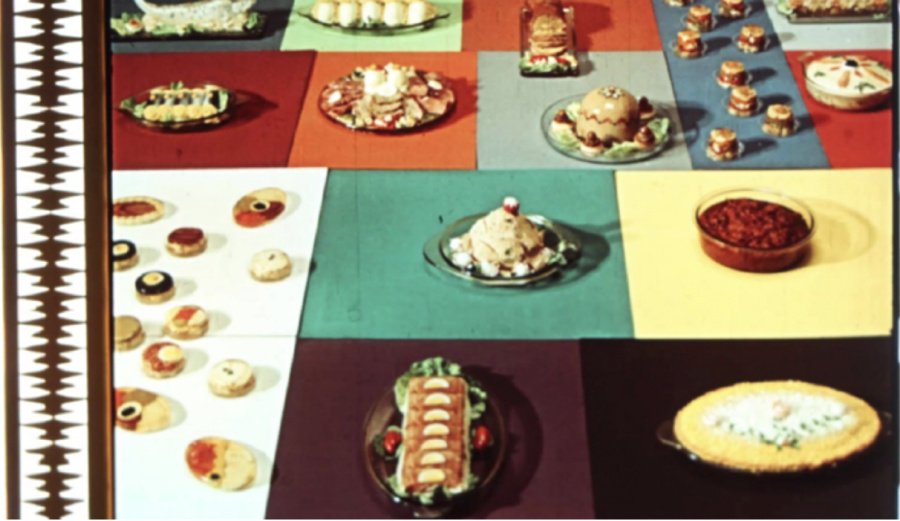
In his film Nutrition Fugue (2018), Hungarian experimental filmmaker Péter Lichter appropriates remnants of discarded film strips from a socialist grocery advertisement (közért, literally, “for the community”), featuring images of processed meat dishes. As an exemplary case of geographically specific materialist film practice, the film functions as both a historical artifact — documenting East Central Europe under the socialist regime — and as a disruptive rupture, bringing past and present materialities into dialogue. This paper argues that Lichter’s process of cutting, decaying, and reassembling the film stock enacts a form of material self-dismemberment that contests dominant (visual and narrative) representational regimes. This ritual undoing of cinematic form resonates deeply with the logic of the ancient Hungarian táltos tradition. The verb tált, meaning “to open wide,” is connected to shamanistic procedures of ecstatic dismemberment, renewal, and revelation, serving as a tool for transmutation and perceptual expansion. This ritualistic transformation constitutes a strategy of cultural re-appropriation. By subjecting embedded cultural images to this process, Lichter dislodges and re-contextualizes official image regimes and contested symbols of national identity, working toward the liberation of human perception against repressive and arbitrary systems. Lichter does this by creating a sensorial field that disorients and expands perception through visual and auditory haptics, facilitating an affective and trance-like encounter and positioning itself as a ritual site where perception is “opened (tált),” and the viewer enters a space of transformation.
Klíčová slova: Hungarian experimental cinema, process cinema, shamanic procedure, visual and auditory haptics
Vloženo: 9. květen 2025; Revidováno: 19. září 2025; Přijato: 3. prosinec 2025; Zveřejněno: 3. únor 2026 Zobrazit citaci
Reference
- Barad, Karen. Meeting the Universe Halfway: Quantum Physics and the Entanglement of Matter and Meaning (Durham and London: Duke University Press, 2007).
 Přejít k původnímu zdroji...
 - Barker, Jennifer M. The Tactile Eye: Touch and the Cinematic Experience (Berkeley: University of California Press, 2009). Přejít k původnímu zdroji...
- Bell, Catherine. Ritual Theory, Ritual Practice (Oxford and New York: Oxford University Press, 2009).
- Colectivo Los Ingrávidos. "Thesis on the Audiovisual," Non-Fiction, no. 3 (2021), accessed September 30, 2025, https://opencitylondon.com/non-fiction/issue-3-space/thesis-on-the-audiovisual/.
- Coulthard, Lisa. "Haptic Aurality: Listening to the Films of Michael Haneke," Film-Philosophy 16, no. 1 (2012), 16-29. Přejít k původnímu zdroji...
- Csuja, László. "A Balázs Béla Stúdió vonzáskörzete: 'Irányított véletlenek' - Lichter Péter," Balkon, no. 1 (2013), 40-43.
- Diószegi, Vilmos. A pogány magyarok hitvilága (Budapest: Akadémiai Kiadó, 1983).
- Dömötör, Tekla. Hungarian Folk Beliefs (Bloomington: Indiana University Press, 1982).
- Eliade, Mircea. Shamanism: Archaic Techniques of Ecstasy, trans. Willard R. Trask (London: Arkana, 1989).
- Gelencsér, Gábor, ed. bbs 50: A Balázs Béla Stúdió 50 éve (Budapest: Műcsarnok, 2009).
- Gerő, András. "A Kossuth kultusz," Mozgó világ 29, no. 4 (2004), accessed September 30, 2025, https://epa.oszk.hu/01300/01326/00038/08gero.html.
- Hornok, Rita. "Turanism as a political myth in the context of the Hungarian politics of memory," Society Register 9, no. 3 (2025), 77-100. Přejít k původnímu zdroji...
- Huigen, Siegfried, and Dorota Kołodziejczyk, eds. East-Central Europe between the Colonial and the Postcolonial in the Twentieth Century (Cham: Palgrave Macmillan, 2023). Přejít k původnímu zdroji...
- Jutz, Gabriele. "Striking Textures, Sensuous Surfaces in Photography and Film," Open Arts Journal, no. 7 (2019), 11-25. Přejít k původnímu zdroji...
- Kim, Jihoon. "Bruce Elder's Film-Digital Hybrids and Materialist Historiography," Millennium Film Journal, no. 56 (2012), 30-40.
- Knowles, Kim. "Self-Skilling and Home Brewing: Some Reflections on Photochemical Film Culture," in Process Cinema: Handmade Film in the Digital Age, eds. Scott MacKenzie and Janine Marchessault (Montreal, Kingston, London, and Chicago: McGill-Queen's University Press, 2019), 75-84. Přejít k původnímu zdroji...
- Kríza, Ildikó. "Táltos as a Supernatural Being in Hungarian Tales and Legends," Ethnographica et Folkloristica Carpathica, no. 5-6 (1988), 257-264.
- Marks, Laura U. Touch: Sensuous Theory and Multisensory Media (Minneapolis: University of Minnesota Press, 2002).
- Nagy, Ádám. "A peremvidék kavalkádja: A Balázs Béla Stúdió vázlatos története és irányzatai,"Filmtett, March 3, 2010, accessed September 30, 2025, https://filmtett.ro/cikk/a-balazs-belastudio-vazlatos-tortenete-es-iranyzatai.
- Pócs, Éva. "The Hungarian Táltos and the Shamanism of Pagan Hungarians: Questions and Hypotheses," Acta Ethnographica Hungarica 63, no. 1 (2018), 149-196. Přejít k původnímu zdroji...
- Romsics, Ignác. Magyarország története (Budapest: Kossuth Kiadó, 2017).
- Simonyi, Sonja. "The Man Behind the Curtain: Gábor Bódy, Experimental Film Culture and Networks of State Control in Late Socialist Hungary," Third Text 32, no. 4 (2018), 519-529. Přejít k původnímu zdroji...
- Stutley, Margaret. An Introduction to Shamanism (London: Routledge, 2003). Přejít k původnímu zdroji...
- Szalay, Dorottya. "Konceptualizmus egy kortárs magyar kísérleti filmben: Lichter Péter: Non-Places: Beyond the Infinite," Alföld, (2016), 88-95.
- Takahashi, Tess. "After the Death of Film: Writing the Natural World in the Digital Age," Visible Language 42, no. 1 (2008), 44-69.
- Takahashi, Tess. "Writing the World: Medium-Specificity and Avant-Garde Film in the Digital Age," in Process Cinema: Handmade Film in the Digital Age, eds. Scott MacKenzie and Janine Marchessault (Montreal, Kingston, London, and Chicago: McGill-Queen's University Press, 2019), 459-483. Přejít k původnímu zdroji...
- Tóth, Margit. Mágia: Hungarian Myth, Magic and Folklore (Woodbury: Lewellyn Worldwide, 2024).
Tento článek je publikován v režimu tzv. otevřeného přístupu k vědeckým informacím (Open Access), který je distribuován pod licencí Creative Commons Attribution 4.0 International License (CC BY 4.0), která umožňuje distribuci, reprodukci a změny, pokud je původní dílo řádně ocitováno. Není povolena distribuce, reprodukce nebo změna, která není v souladu s podmínkami této licence.